
Australia Skilled Migration 2026–2027
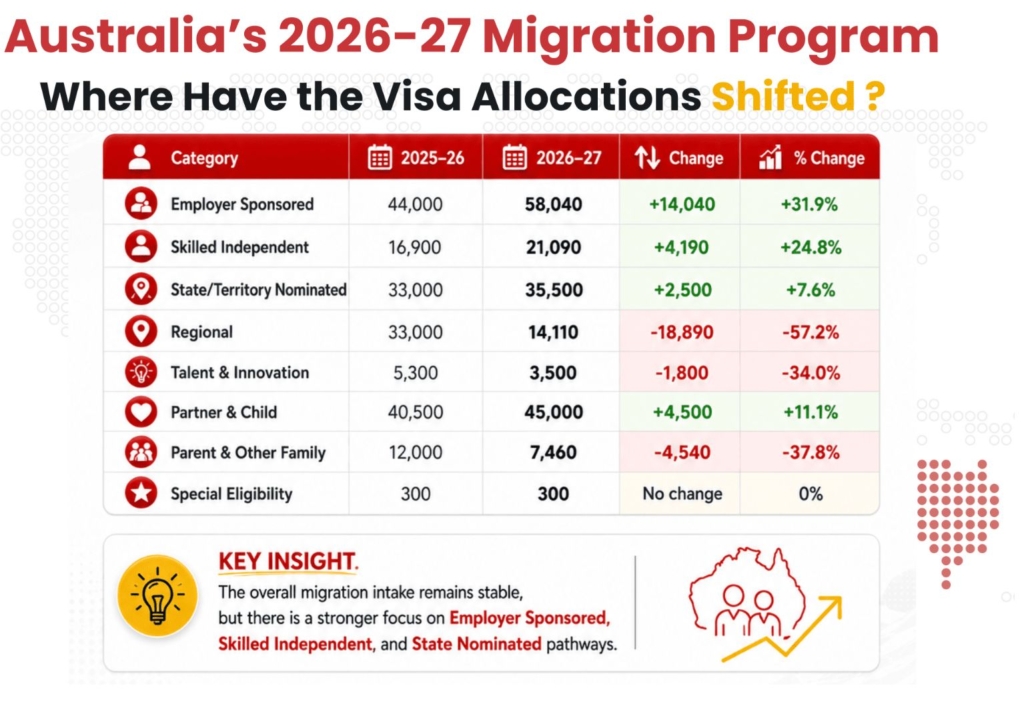
Australia Skilled Migration 2026–2027
For skilled professionals considering Australia as their next destination, where you choose to live can be just as important as the visa you apply for.
Australia’s states and territories each have their own economic priorities and workforce shortages. As a result, an occupation that is highly sought after in one jurisdiction may not receive the same level of attention in another.
Your occupation, qualifications, work history, English language ability, points score, and preferred location can all influence which nomination pathway is worth considering.
With skilled migration continuing to play an important role in addressing workforce shortages, understanding how state and territory programs operate can help applicants make better-informed decisions in 2026–2027.
Understanding State and Territory Nomination
State and territory nomination is designed to connect skilled migrants with workforce needs identified by individual Australian jurisdictions.
Eligible applicants may be considered for nomination through two key skilled visa pathways:
Subclass 190 — Skilled Nominated Visa
The Skilled Nominated visa (subclass 190) provides a permanent visa pathway for eligible skilled applicants who are nominated by an Australian state or territory.
Subclass 491 — Skilled Work Regional Visa
The Skilled Work Regional visa (subclass 491) is a provisional pathway for eligible skilled workers who are nominated to live and work in an eligible regional area.
Importantly, each jurisdiction sets its own priorities. Simply being eligible for a skilled visa does not mean that an applicant will automatically receive state nomination.
Applicants should consider factors such as:
- Whether their occupation is currently targeted
- Their points score
- Relevant employment history
- Qualification and skills assessment requirements
- English language proficiency
- State-specific conditions
- Commitment to living in the nominated location
What Could Shape State Nomination in 2026–2027?
Australia’s skilled migration environment can change throughout the program year. Several broad factors are particularly relevant to applicants:
1. Skilled Workers in Critical Industries Remain Important
Many parts of the Australian economy continue to require qualified workers.
Depending on the jurisdiction and current labour market conditions, occupations that may feature among skilled migration priorities include:
- Healthcare and nursing
- Education and teaching
- Engineering
- Information technology
- Construction
- Infrastructure
- Skilled trades
The level of demand is not identical across Australia. Applicants should therefore assess their occupation against the requirements of individual states rather than assuming that a national skills shortage will automatically result in nomination.
2. Regional Settlement Continues to Matter
Australia continues to encourage skilled migration to regional communities where employers and local economies require additional workers.
For suitable applicants, regional migration can be an alternative to focusing exclusively on Sydney, Melbourne, Brisbane, or other major metropolitan centres.
The subclass 491 visa is particularly relevant to applicants considering regional settlement. Depending on individual circumstances, regional locations may offer:
- Employment opportunities
- Access to different nomination programs
- Growing local economies
- Lifestyle advantages
- Opportunities outside Australia’s major capitals
Note: Applicants should remember that regional migration generally comes with specific location and visa conditions.
3. A Strong Profile Can Be Important
State nomination programs can attract a large pool of applicants, particularly for occupations with limited places.
A competitive profile may include:
- A strong points score
- High English proficiency
- Relevant skilled employment
- Appropriate qualifications
- A suitable skills assessment
- Experience in an occupation targeted by the jurisdiction
- A genuine commitment to meeting state or regional requirements
Applicants should not assume that meeting the minimum eligibility threshold guarantees an invitation.
4. State Programs Are Not Static
One of the biggest challenges for prospective migrants is that state nomination programs can change.
Governments may adjust their priorities in response to:
- Labour market shortages
- Available nomination places
- Economic conditions
- Regional workforce requirements
- Changes in the skilled migration program
This means an occupation that was eligible previously may not necessarily remain a priority. Always check current state or territory information before submitting an expression of interest or nomination application.

